Medical Device Validation: Types, Process, Requirements, and How to Prepare
Yash Dave
Medical device validation is one of the most important activities in the medical device lifecycle. It helps confirm that a device, process, software system, or connected healthcare product performs as intended and meets the needs of users, patients, and real-world clinical environments.
For medical device companies, validation is not just a regulatory requirement. It directly impacts product safety, quality, usability, performance, market readiness, and long-term trust.
But medical device validation is not one single activity. Depending on the product, validation may include design validation, process validation, software validation, usability validation, packaging validation, sterilization validation, cybersecurity validation, data integrity validation, and AI model validation.
That is why validation should be planned early, connected to risk, and supported with strong documentation.
This guide explains what medical device validation means, how it differs from verification, the major types of validation, what documents are usually needed, common mistakes to avoid, and how MedTech teams can prepare better.
Building a medical device, SaMD product, connected health platform, or healthcare software system? AIMDek helps MedTech companies build validation-ready products with V&V, software engineering, test automation, interoperability, cloud, cybersecurity, and AI capabilities.
What Is Medical Device Validation?
Medical device validation is the process of proving, with documented evidence, that a medical device meets its intended use and user needs under defined conditions.
In simple terms, validation answers this question:
Did we build the right product for the right users and the right intended use?
For example, if a wearable medical device is designed to monitor patient vitals, validation should confirm that the device works as expected for the intended patient population, use environment, and health-monitoring workflow.
Validation is important because medical devices are used in real healthcare settings where product failure, incorrect readings, poor usability, software defects, or data errors can affect patient safety and clinical decision-making.
Medical Device Validation vs Verification
Validation and verification are closely related, but they are not the same.
Verification confirms that design outputs meet design inputs. In simpler terms, it checks whether the product was built correctly according to specifications.
Validation confirms that the device meets user needs and intended use. In simpler terms, it checks whether the right product was built for the right real-world use case.
For example:
- If a requirement says that a mobile app should display SpO2 readings within 3 seconds, verification checks whether the app meets that requirement.
- Validation checks whether the full device-app workflow is usable, reliable, understandable, and appropriate for the intended user and environment.
Both are necessary. Verification proves that requirements were met. Validation proves that the product is suitable for its intended purpose.
Why Medical Device Validation Matters
A strong validation approach helps medical device companies:
- Confirm that the product meets intended use and user needs
- Reduce patient safety risks
- Identify usability, performance, and workflow issues before launch
- Support regulatory submissions and audits
- Maintain objective evidence for quality systems
- Improve traceability between requirements, risks, tests, and outcomes
- Reduce late-stage rework
- Prepare for future product changes and revalidation
For software-driven medical devices, validation also helps confirm that software, mobile apps, APIs, cloud platforms, device integrations, dashboards, and data workflows behave reliably across real-world scenarios.
Types of Medical Device Validation
The validation activities required for a medical device depend on device type, intended use, risk level, software involvement, manufacturing process, and target market.
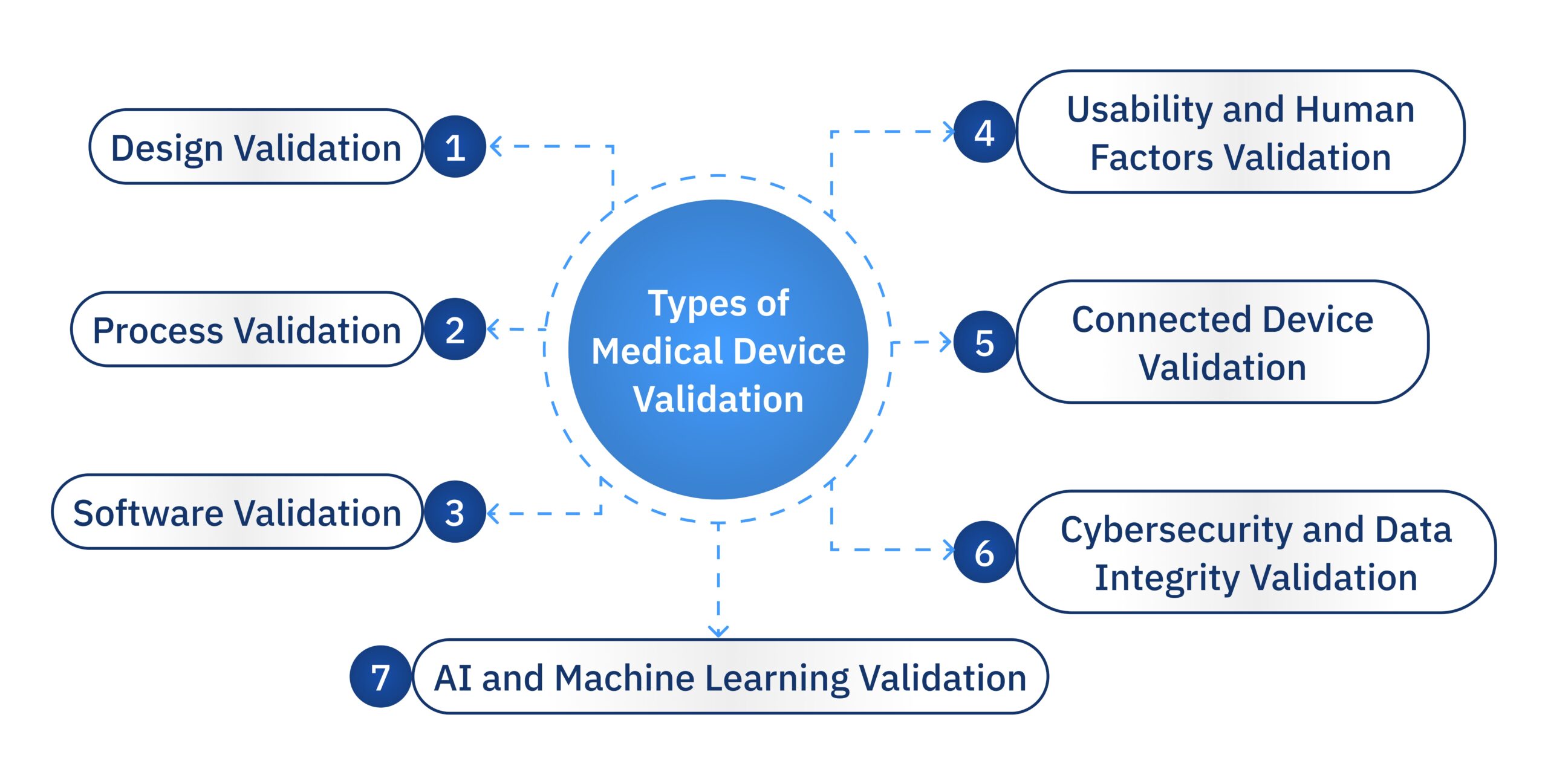
Below are the major types of medical device validation.
1. Design Validation
Design validation confirms that the final device design meets user needs and intended use. It usually includes testing under actual or simulated use conditions.
Design validation may involve:
- Intended use validation
- User needs validation
- Performance testing
- Simulated-use testing
- Human factors and usability testing
- Risk control validation
- Software validation, where applicable
Design validation is important because a product can meet technical requirements and still fail if it does not work properly for real users in real use conditions.
2. Process Validation
Process validation confirms that a manufacturing, production, or operational process consistently produces results that meet predetermined specifications. This is especially important when the final output cannot be fully verified through later inspection or testing.
Process validation may include:
- Installation Qualification, also called IQ
- Operational Qualification, also called OQ
- Performance Qualification, also called PQ
- Equipment validation
- Manufacturing process validation
- Cleaning validation
- Sterilization process validation
- Packaging process validation
For AIMDek’s audience, this section is useful for context, but process validation is typically handled by manufacturing, quality, and specialized validation teams.
3. Software Validation
Software validation confirms that medical device software, or software used in medical device development, production, testing, or quality systems, performs as intended. This is increasingly important because many modern medical devices depend on software, mobile applications, firmware, cloud platforms, APIs, dashboards, AI models, and connected data workflows.
Medical device software validation may include:
- Software requirements validation
- Functional testing
- Regression testing
- Integration testing
- System testing
- Automated testing
- Cybersecurity testing
- Data integrity testing
- Performance testing
- Traceability between requirements, risks, and tests
Software validation is especially important for SaMD, connected medical devices, remote patient monitoring platforms, wearable medical devices, and AI-enabled healthcare products.
If your medical device depends on software, mobile apps, cloud platforms, APIs, connected data flows, or AI features, AIMDek can help you build the engineering and testing foundation needed for validation-ready development.
4. Usability and Human Factors Validation
Usability validation confirms that intended users can use the device safely and effectively in the intended environment.
This matters because many device risks come from user interaction, workflow confusion, unclear instructions, poor interface design, alarm fatigue, or incorrect interpretation of outputs.
For connected devices and healthcare apps, usability validation should also consider onboarding, device pairing, alerts, dashboards, patient instructions, clinician workflows, and data visualization.
5. Connected Device Validation
Connected medical devices often involve multiple components working together. A device may collect data, transfer it to a mobile app, sync it with the cloud, process it through APIs, display it on a dashboard, and share it with clinical systems.
Connected device validation should confirm that the full ecosystem works reliably.
This may include:
- Device-to-app connectivity testing
- BLE, Bluetooth, Wi-Fi, or gateway testing
- Firmware-app compatibility testing
- Mobile-cloud sync validation
- Offline and reconnect scenarios
- Data transfer validation
- API validation
- Alert and notification testing
- Failure mode testing
For modern IoMT and wearable medical devices, validation must go beyond the physical device. The complete digital ecosystem matters.
AIMDek supports MedTech companies with connected medical device engineering, IoMT integration, BLE workflows, cloud platforms, data pipelines, and end-to-end device-to-cloud testing.
6. Cybersecurity and Data Integrity Validation
Cybersecurity validation helps confirm that security controls work as expected and that the device ecosystem protects sensitive healthcare data.
Data integrity validation confirms that data is captured, transmitted, stored, processed, displayed, and reported correctly.
These areas are especially important for:
- Wearable devices
- Remote patient monitoring platforms
- Diagnostic software
- Clinical dashboards
- AI-enabled decision support workflows
- EHR integrations
- Cloud-based medical device platforms
Validation may include authentication testing, role-based access testing, API security testing, encryption validation, audit log validation, database validation, report validation, and data transfer testing.
If a device captures accurate data but the app, cloud system, or dashboard displays it incorrectly, the overall product may still fail validation expectations.
7. AI and Machine Learning Validation
AI-enabled medical devices and healthcare software products introduce additional validation challenges.
AI validation may need to consider:
- Dataset quality
- Intended use boundaries
- Model performance
- Bias and fairness
- Explainability
- Clinical workflow fit
- Human oversight
- Model drift
- Change management
- Post-market performance monitoring
For AI-enabled medical devices, validation should not only focus on whether the model performs well during development. It should also consider how the AI output is used, who acts on it, what risks exist, and how performance will be monitored after deployment.
Building AI-enabled healthcare software or AI-powered SaMD? AIMDek helps teams design AI systems with data pipelines, workflow integration, monitoring, traceability, and compliance-by-design engineering practices.
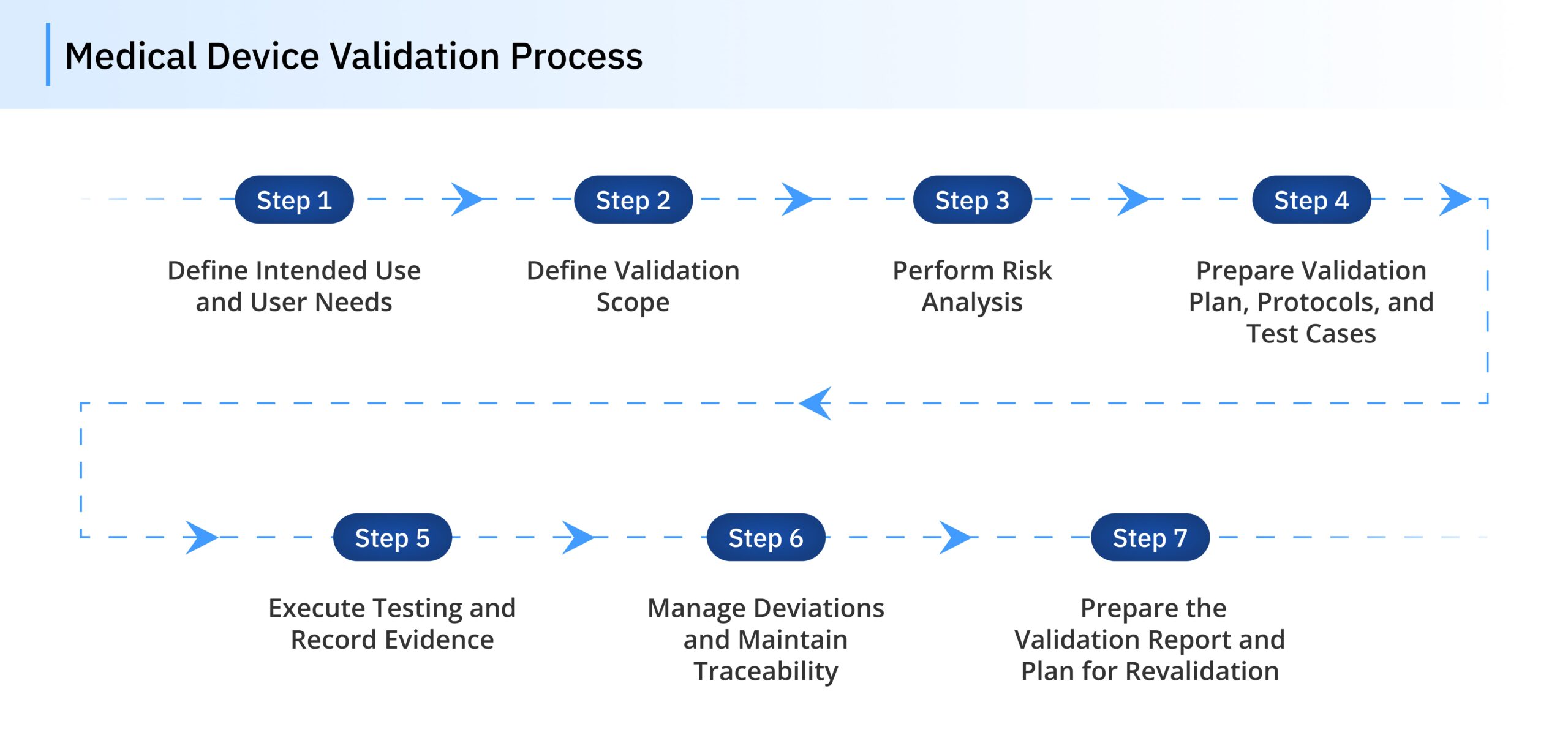
Medical Device Validation Process
A practical medical device validation process usually follows these steps.
Step 1: Define Intended Use and User Needs
Validation starts with a clear understanding of the device’s intended use, users, patient population, use environment, and expected outcomes.
This should define:
- Who will use the device
- Where the device will be used
- What the device is intended to do
- What users need from the product
- What risks need to be controlled
Weak intended use and user needs can create validation gaps later.
Step 2: Define Validation Scope
Not every product needs the same validation scope. The scope should be based on device type, risk level, software involvement, manufacturing process, and regulatory expectations.
The validation scope may include the device design, manufacturing process, software, firmware, mobile app, cloud platform, APIs, AI model, data workflows, usability, cybersecurity, interoperability, packaging, or sterilization.
The goal is to define what needs to be validated and why.
Step 3: Perform Risk Analysis
Risk analysis helps determine which functions, workflows, components, and processes need stronger validation evidence.
For software-driven medical devices, high-risk areas may include:
- Data accuracy
- Alerts and notifications
- Measurement workflows
- Device pairing
- Patient identification
- Access control
- Data transfer
- AI-generated outputs
- Security controls
Risk should be connected to requirements, test cases, acceptance criteria, and validation evidence.
Step 4: Prepare Validation Plan, Protocols, and Test Cases
Usability validation confirms that intended users can use the device safely and effectively in the intended environment.
This matters because many device risks come from user interaction, workflow confusion, unclear instructions, poor interface design, alarm fatigue, or incorrect interpretation of outputs.
For connected devices and healthcare apps, usability validation should also consider onboarding, device pairing, alerts, dashboards, patient instructions, clinician workflows, and data visualization.
Test cases should connect to:
- User needs
- Intended use
- Requirements
- Risk controls
- Design outputs
- Software features
- System workflows
For software and connected devices, test cases should cover expected workflows, edge cases, and failure scenarios.
Step 5: Execute Testing and Record Evidence
During validation execution, the team performs approved tests and records results. :
Validation evidence should include:
- Test date
- Test environment
- Test data
- Tester details
- Steps performed
- Expected results
- Actual results
- Pass/fail status
- Screenshots, logs, or reports
- Deviations or defects
- Retesting evidence, if needed
Incomplete evidence can weaken validation readiness even if the product works correctly.
Step 6: Manage Deviations and Maintain Traceability
Failed test cases, deviations, and unexpected results should be documented and investigated.
Teams should identify what failed, why it failed, whether the failure affects safety or performance, whether a design change is needed, and whether retesting is required.
Traceability connects user needs, requirements, risks, tests, results, and release evidence. It helps show that every critical requirement and risk control has been tested and documented.
Step 7: Prepare the Validation Report and Plan for Revalidation
The validation report summarizes the validation activity, results, deviations, risk impact, acceptance criteria status, and final conclusion.
Validation may need to be repeated when there are changes to device design, software features, firmware, cloud infrastructure, manufacturing process, suppliers, AI model behavior, intended use, user population, or regulatory requirements.
For software-driven products, revalidation planning is especially important because software releases, mobile OS updates, cybersecurity patches, API updates, cloud changes, and firmware updates can affect performance and safety.
Medical Device Validation Documentation
Good validation depends on good documentation. Documentation provides objective evidence that validation was planned, executed, reviewed, and approved.
Common medical device validation documents include:
- Intended use statement
- User needs document
- Design input requirements
- Software requirements specification
- Risk management file
- Validation plan
- Validation protocol
- Test cases
- Test scripts
- Test data records
- Traceability matrix
- Deviation report
- Defect logs
- Validation summary report
- Change control records
- Release notes
- Approval records
For software and connected device products, documentation may also include architecture documents, API specifications, cybersecurity risk assessments, threat models, data flow diagrams, cloud infrastructure documentation, automation test reports, audit logs, AI model documentation, and monitoring records.
AIMDek can support MedTech teams with validation-ready engineering documentation, test automation, traceability support, software quality practices, and V&V execution for healthcare software and connected medical device ecosystems.
Common Medical Device Validation Mistakes
Medical device validation becomes difficult when it is treated as a final-stage activity instead of a lifecycle activity.
Here are common mistakes to avoid.
1. Starting Validation Too Late
If validation is planned only near release, teams may discover missing requirements, weak traceability, unclear acceptance criteria, or insufficient evidence.
Validation should be considered during product planning, architecture, design, development, and testing.
2. Poorly Defined User Needs
Validation depends on user needs and intended use. If these are vague, incomplete, or not testable, validation becomes difficult.
User needs should be specific enough to support meaningful validation.
3. Weak Traceability
Without traceability, it becomes difficult to prove that requirements, risks, and test cases are connected.
This is especially risky for software, AI, connected devices, and cloud-based platforms where changes happen frequently.
4. Ignoring Real-World Use Conditions
A device may perform well in controlled testing but fail in real use.
Validation should consider realistic users, environments, workflows, network conditions, device states, errors, and edge cases.
5. Treating Software as a Small Add-On
Many modern medical devices depend heavily on software. Mobile apps, dashboards, firmware, APIs, cloud infrastructure, analytics, and AI workflows can directly affect product performance and safety.
Software should be included in validation planning from the beginning.
Where AIMDek Can Help with Medical Device Validation
AIMDek supports MedTech, digital health, and medical device companies with engineering capabilities that make products more validation-ready from the beginning.
Some validation areas, such as sterilization, cleaning, packaging, and manufacturing process validation, are usually handled by specialized manufacturing and quality teams. AIMDek helps where medical device validation intersects with software, connectivity, data, cloud, AI, cybersecurity, interoperability, and digital product engineering.
AIMDek can support teams with:
- Medical device software development
- SaMD engineering
- Software verification and validation support
- Health and companion app development
- Connected device and IoMT engineering
- BLE and device-to-cloud workflows
- Cloud platform development
- API and data pipeline testing
- FHIR and healthcare interoperability
- AI-enabled healthcare software development
- Test automation
- Cybersecurity testing support
- Data integrity validation support
- Traceability and validation-ready documentation
- V&V execution for software-driven medical device ecosystems
Planning a medical device, SaMD, connected health platform, or AI-enabled healthcare product? AIMDek helps MedTech teams build, test, integrate, and document software-driven medical device ecosystems with quality-first engineering practices.
Medical Device Validation Checklist
Use this checklist as a starting point for validation readiness.
- Is the intended use clearly defined?
- Are user needs documented?
- Are design inputs complete and testable?
- Are risks identified and linked to controls?
- Is the validation scope defined?
- Are software, cloud, mobile, firmware, and AI components included where relevant?
- Are validation protocols approved before execution?
- Are acceptance criteria clear?
- Are test environments controlled?
- Are test results documented?
- Are deviations recorded and resolved?
- Is traceability maintained?
- Is cybersecurity considered?
- Is data integrity tested?
- Is usability tested with intended users?
- Is revalidation planning defined for future changes?
- Is the final validation report approved?
Final Thoughts
Medical device validation is essential for proving that a device, process, software system, or connected healthcare ecosystem performs as intended and meets user needs.
For modern medical device companies, validation is becoming more complex because products are no longer limited to hardware alone. Many devices now include software, firmware, mobile apps, cloud platforms, APIs, AI models, cybersecurity controls, data pipelines, and interoperability workflows.
The best approach is to plan validation early, connect it to risk, maintain strong traceability, document evidence properly, and design systems in a way that supports future change.
Medical device companies that treat validation as a lifecycle activity, not just a final-stage requirement, are better prepared for regulatory expectations, product quality, patient safety, and long-term scalability.
Need help building validation-ready medical device software, SaMD, connected device platforms, or AI-enabled healthcare systems? AIMDek works with MedTech teams across product engineering, V&V, test automation, cloud, interoperability, cybersecurity, and AI development.