Top 7 DevOps Trends To Digitally Transform Your Business At Scale
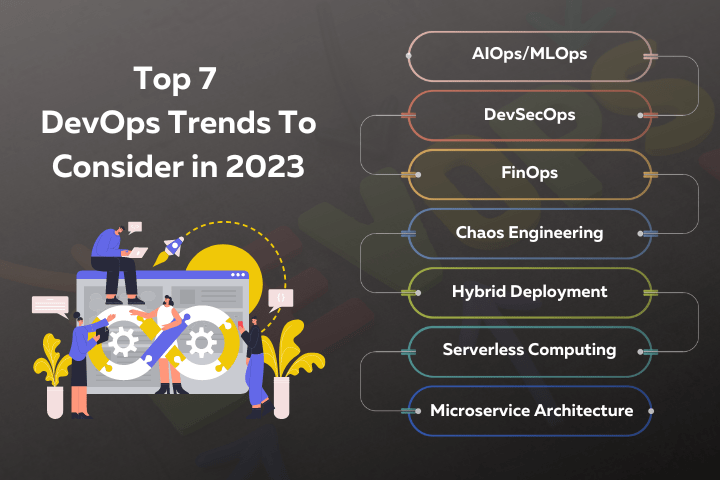
Top 7 DevOps Trends To Digitally Transform Your Business At Scale Avakash Dekavadiya From startups and small businesses to large enterprises are stepping up the digital game with DevOps adoption. However, it’s not essential that every company drive success by embracing DevOps because DevOps trends are changing at speed. Only those companies gaining an edge in the fierce competition have successfully implemented DevOps trends. That’s why knowing and analyzing DevOps trends in 2023 is imperative to maximize business value and efficiency. Collaborating with DevOps consulting services, you get to know which DevOps trends fit well with your development cycle. Let’s take a look at all the DevOps trends that shape your business digitally in 2023. Top 7 DevOps trends to consider in 2023 AIOps/MLOps Guaranteeing high-quality, and rapid development is the need of the hour to automate IT operations and processes. That’s where AIOps and MLOps play a vital role in increasing productivity by identifying the root cause of issues before they impact processes and operations. The BFSI industry is leveraging AIOps at scale for different activities such as real-time monitoring, delivering information, suspicion pattern detection, and automated problem-solving. The DevOps trend has helped BFSI to secure data, resolve configuration and capacity issues that improved overall efficiency. For instance, IBM launched IBM Cloud Pak for Watson AIOps to close the gap in data context identification. The version provides user context to the key stakeholders that help them identify the problems negatively impacting performance. Fortinet has also supercharged automated security solutions with AIOps capabilities to make the system the most secure and safe. DevSecOps Security is a cardinal aspect of every digital application. Realizing this need, the DevSecOps trend comes into the picture that ensures the best security practices followed during the DevOps lifecycle. According to this DevOps trend, the shift-left approach is followed by half of the enterprises of the world. For instance, the Pokemon Go app was launched by teaming up with Niantic company which has taken care of app development and security. Post-GDPR launch, Pokemon Go has to protect the data privacy of 800 million children that have downloaded the app. For the best management of shared data and responsibility, Pokemon Go adopted DevSecOps to introduce a security culture wherein automated security checks take care of children’s data privacy every time. FinOps The DevOps trend is dedicated to optimizing the cloud spending of the companies to increase the bottom line. Mainly, it empowers collaboration among different teams to bring financial accountability to cloud expenses. It enables the chief financial officer, chief technical officer, and chief information officers to collaborate and balance cost, speed, and quality at an enterprise level. Wire- the media institution embraced the FinOps trend to control cloud spending, minimize resource management, and better manage infrastructure. The company partnered with Centilytics for FinOps solution adoption to get a report of improvements to be made followed by a wastage tracker. It has helped Wire to reduce cloud computing and cloud infrastructure cost by a large margin. Chaos Engineering Nearly 40% of DevOps leverage chaos engineering trends while using DevOps in the digital transformation journey. It involves introducing flaws of faulty scenarios in the software deliberately to check the app’s reliability. Analyzing different behaviors of the app, the real cause of the breakpoints is identified before deployment so that a robust app is released to the market that can handle immense pressure. Netflix is the best instance of chaos engineering trend adoption that has made the app robust against various mishaps by enhancing its fault tolerance capabilities. The data operations are moved to cloud infrastructure and chaos monkey is continuously run to test the app’s reliability in handling unfortunate outages without affecting user experience on the front end. Hybrid Deployment For businesses that have the on-premise infrastructure to manage data and operations traditionally, the results are not so good. They prefer complete cloud migration but that’s a little difficult for large enterprises. That’s where hybrid deployment is a panacea. It involves extending on-premise infrastructure resources with cloud computing resources by creating a path to the cloud service providers. It enables the in-house team and cloud team to work collaboratively. British Petroleum spends haphazardly on data centers and on-premise infrastructure. The organization opts to shift the data center workload to the cloud by partnering with Microsoft company through a hybrid cloud approach. Serverless Computing Serverless computing scores high popularity because they enable developers to engineer and run applications without a server. It eliminates the server management needs thereby creating innovative approaches for app deployment. Serverless computing closes the gap between the development and operation teams. Autodesk company that’s designing software for various industries has increased its AWS footprint to accelerate development time for reducing time-to-market the app. The account creation process of AWS that was taking more than two weeks impacting the performance. So, the company opted to transition to serverless computing which has reduced the account creation process to 10 minutes. Microservice Architecture Microservice architecture is majorly leveraged for simplifying development, testing, and deployment by breaking the application into manageable chunks. It facilitates IT teams to develop and deploy quality apps at speed and streamline the DevOps process. Coca-Cola opted for microservice architecture to cope with network congestion that was created due to hundreds of product management using the legacy-based infrastructure. Also, the architecture has helped the company to diminish the time needed for supporting more machines to a few minutes. Looking For DevOps Development Services? CONTACT OUR EXPERTS NOW How AIMDek can help you empower businesses with DevOps trends? The DevOps trends enable companies to stay ahead of the curve in the digital transformation journey. However, the knowledge of DevOps trends is not enough to implement the DevOps trends rightly. You need DevOps development services from a reliable development partner that can help you with custom solution integration meeting business digital needs. The AIMDek team understands the requirements for a secure and scalable solution, then tests and monitors the developed solution before it goes live. It helps companies release the app in reduced
Microsoft Rolled Out New Updates For Azure SQL Database: Know In Detail

Microsoft Rolled Out New Updates For Azure SQL Database: Know In Detail Avakash Dekavadiya Traditional software development services such as databases, networking, and servers have undergone enormous changes after cloud computing takes the driver’s seat. Cloud services have made software development cost-efficient with improved developers’ productivity, increased access to resources, global distribution, and reduced hardware costs along with associated expenses. Businesses are also moving their traditional database to the cloud to enjoy the benefits of flexible, affordable, and scalable database management. Azure SQL Database stands out as the best PaaS database engine that handles most of the database management without any user interference. Let’s understand it in detail. What is Azure SQL Database? One of the best Azure SQL databases is a relational database service that runs on a stable SQL server database engine. With in-built PaaS capabilities allow developers to focus on critical domain-specific database optimization and administration activities. It enables the creation of a high-performance data storage layer for the applications and modern cloud solutions because it enables the processing of both types of data structure- relational data structure and non-relational data structure. Key capabilities of Azure SQL Database include- Scalable performance Serverless computing Advanced monitoring and troubleshooting Automatic backups Point-in-time restores Built-in intelligence Adaptive query processing Advanced security and threat protection mechanism With changing market trends and customer demands evolution, the applications must step in with the changes. In the same vein, Microsoft continuously upgrades Azure SQL Database Service to meet the modern application development demands. Here, we have come up with Top Azure SQL Database Upgrade 2022 to know what’s added, modified, and removed in the latest version. Which are the updates rolled out in the latest Azure SQL Database release? Active geo-replication It’s one of the Best Azure SQL Database feature updates that allow developers to create a continuously synchronized readable secondary database for the primary database. The readable secondary database that’s also referred to as geo-replicas help businesses perform disaster recovery of individual database quickly in the event of unexpected failure or large-scale outage. When geo-replication is set up, geo-failover is initiated anytime either manually or programmatically via the application. Following diagram showcase how geo-redundant cloud configuration leverages active geo-replication. When if the primary database fails somehow, the geo-failover initiation of any secondary database will promote the secondary database to the primary role, and the rest of the secondary databases get linked to it automatically. Using the always-on availability group on technology, the active geo-replication asynchronously replicates the transactions log that’s created from the primary replica to all geo-replicas. The secondary databases though a little behind the primary database, but data is always transactionally consistent. Active geo-replication is also leveraged for application upgrades and data migration, in addition to disaster recovery. Geo-replication also helps with Azure Database Migration Services that enable migrating databases from one server to another with reduced downtime. Also, during application upgrades, geo-replication helps in creating an extra fail-back copy. Active geo-replication helps with automatic asynchronous replication, planned geo-failover, unplanned geo-failover, creating multiple readable geo-secondaries, user-controlled geo-failover, and geo-replication of databases in an elastic pool. When the app needs a stable connection endpoint and automatic failover support, then auto-failover groups come to the rescue. Auto-failover groups Auto-failover groups are designed to simplify the deployment and management of the geo-replicated databases on the top of the active geo-replication feature. It allows developers to best manage failover and replication of a few or all the databases on a logical server. The geo-failover is initiated either manually or by the Azure SQL Database Service. the latter alternative is more preferred as they automatically recover multiple related databases after the unplanned event or catastrophic failure that results in the loss of databases. The secondary databases are also used in failover groups to offload read-only workloads by the developers to minimize the traffic to the primary database. The end-points are also provided by auto-failover groups that remain unchanged during and after the geo-failover as connection strings are automatically routed to the primary database. A failover group in the Best Azure SQL Database includes multiple databases used by the same app. When auto-failover groups are used with the automatic failover policy, the outage impacting databases results in automatic geo-failover. The auto-failover group is configured on the primary server and connected to secondary databases in another region. The diagram below showcases the configuration of the geo-redundant cloud app using an auto-failover group. Ledger Update to ledger has also remained as the top Azure SQL Database Upgrade 2022 that improves data protection by preventing fraudsters or high-privilege users such as cloud administrators, system administrators, or database administrators to tamper with the data. With tamper-evidence and cryptographically attestation capabilities, the ledger helps in ensuring data has not tampered with. Ledger preserves historical data by maintaining its previous value in the history table and provides a chronicle of all changes made to the database. Ledger functionality comes in two flavors- an updated ledger table or an append-only ledger table. This feature is a great help for digital forensics, streamlining audits, off-chain storage for blockchain, and other processes. Changed data capture Change data capture works like its name, that’s it keeps a record of all the changes made to the database. It records all the activities such as addition, updation, or deletion applied to the table using an SQL server agent. Consequently, the detail of changes gets available in relational format. In the latest update, it’s available for Azure SQL Database which helps a ton during migration. Saying the latest update to this feature is a boon for Azure Database Migration Services as it’s easy to access the changes made to data or any errors if it occurs. The change data capture scheduler feature in the best Azure SQL Database takes the place of SQL server agent for regular capture and cleanup of change data capture tables without taking the help of any external dependency. Zone redundant configuration Azure availability zone in Azure SQL Database ensures that the database remains up and running 99.99% of the time
Digitally Transforming the Electrical Manufacturing Industry: Is it a Trend or a Necessity?
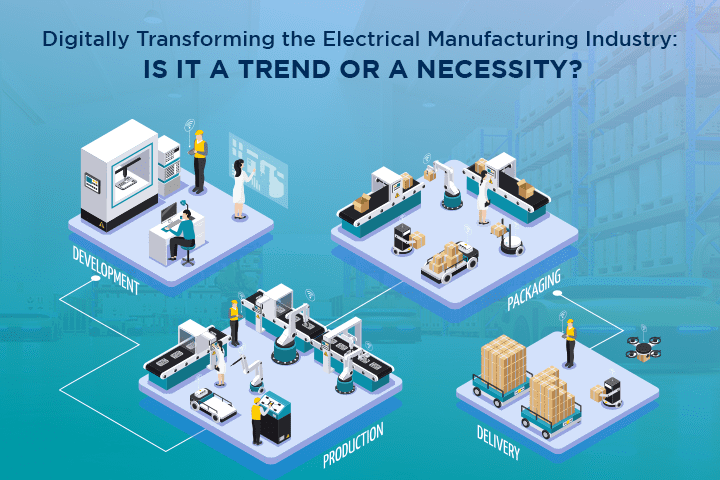
Digitally Transforming the Electrical Manufacturing Industry: Is it a Trend or a Necessity? Avakash Dekavadiya The revolutions in the industry have been consistently evolving and modifying our lives since the 18th century. From then, we saw the release of mechanical production, moving to electrical energy, and landing on electronics applications. All these steps have helped us reach the age of technology we are now living in. But, today, it is the age of digital transformation in the electrical manufacturing industry. Digital transformation is slowly modifying manufacturing Now we have quicker processes, smarter systems, flexible management, and an efficient supply chain. In this article, we will explore how digital transformation can affect the electrical manufacturing industry. When Is The Right Time For Transformation? The time for digital transformation is right now! Due to the pandemic, the daily habits and lives of many people have been disrupted. The biggest impact was seen in the manufacturing and electrical industry. Various manufacturers across the globe reduced their capacity or shifted to a new model. Many others struggled to manage the supply chain and movement of electrical goods across borders. With this, a large number of the workforce was home quarantined or isolated. According to experts, this ‘New Normal’ might not go away completely for a while. What we can do is utilize technology, such as CRM, to enhance customer relationships, improve supply chain tracking, and reduce time to market. How CRM Solutions Improve Services in the Electrical Manufacturing Industry? Using CRM in your business offers more opportunities for business growth, process-oriented tasks, etc. With this implementation, it is possible to upgrade the way we do business and spend our time in supply chain management, customer engagement, etc. Let’s see how Microsoft solutions can help you utilize a robust, secure, and converting CRM service. Supply Chain Management Supply chain management is the engine of the manufacturing industry. When we utilize advanced technologies, such as CRM, to enhance and uplift processes, we get optimized capacity, improved quality, better performance, and increased supply chain operational efficiency. The reason why customer relationship management tools help in streamlining the supply chain is that it keeps track of every process. You get updated data at any instance for further business decisions. Better Time to Market Many companies utilize digital transformation to reduce time to market. In the electrical industry, you can use Microsoft CRM to improve the entire functioning, which helps you release the product in the market sooner than later. This technology is designed to support different product stages, eliminate inefficiencies, offer data-driven insights, and integrate with ERP systems to augment the entire development lifecycle. These capabilities of the CRM help in grasping new opportunities and saving time. Customization With digital transformation technologies like CRM, the entire product lifecycle is streamlined and connected. It is not a linear process, but an enhanced networked process, using state-of-the-art tools and machines that make production agile and flexible. With the help of these tools, we gain the power to customize the supply chain and processes involved in it. Lower Risks One of the biggest benefits of using CRM is to avoid risks posed by various environmental and process-related factors. Digital tools like CRM are built with analytics. This means you get the updated insights on product simulations, tests, and user expectations. Using this data, you can modify your performance, improve your product’s structure, and impart high quality to users. This data also helps in identifying potential challenges and risks of new products through predictive analysis, which helps you plan your new production accordingly. Productivity and Customer Engagement Using your business data and its details from one location offers the convenience to quickly navigate and utilize data. Your stakeholders don’t need to search multiple systems to receive data that is relevant and new. This is why CRM helps in saving time and improving employee productivity. Other than this, CRM is designed to help you seamlessly coordinate with customers. You can use key insights related to every customer or customer group, which can be used to improve the experience through personalized communications. Conclusion If we have to sum up the above discussion, digitization is already here. We are not really waiting for a swift change. It is happening slowly and organizations in the electrical manufacturing industry should adapt to this digital change. Accept digital transformation and utilize Microsoft solutions to seamlessly deal with supply chain disruption and unexpected shifts in operations. Move towards productivity and operational efficiency. AIMDek Technologies is a software development company that has helped many customers transform digitally. Due to our industry experience and evolution throughout these years, we have gained the experience and skills to help your electrical manufacturing organization implement the right Microsoft solutions. Visit our website, explore more about our solution, and receive quick consulting on your new digital transformation plan. skip render: ucaddon_next_prev_post