How can Implementing Chatbots in Car Dealerships Improve Customer Experience?
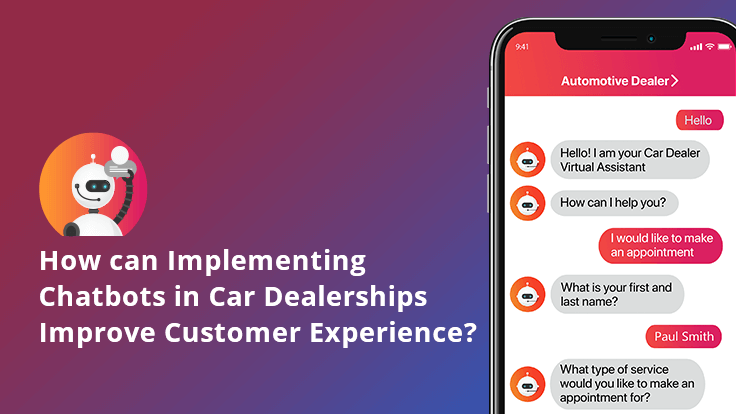
How can Implementing Chatbots in Car Dealerships Improve Customer Experience? Avakash Dekavadiya Modern automotive dealerships are undergoing role reconfiguration. Conventionally, the automotive industry had been a product-centric industry and it was the products (cars/services) that fetched customers to the dealerships. Not anymore. Today in an increasingly digital marketplace, the auto industry is continually evolving as a customer-centric industry wherein customer engagement and customer experiences are driving the auto industry. Moreover, the real essence of customer engagement lies in personalization. Customers, expect a seamless, easy and cross-channel customer experience that is personalized to their specific needs. In car dealerships, hospitality essentially depends on how a customer feels while dealing with them. This blog will describe how can implementing chatbots in car dealership improve customer experience. So, what are chatbots? Chatbots (Chat ROBOT) can be defined as a software that offers conversational experience by providing a textual or verbal interaction with real-world people using the native language. Chatbots are primarily designed to imitate normal human responses. Chatbots are a great way to drive customer engagement and help streamline dealership’s in-house operations with a contextual helper without ever involving a human.The chatbot adoption in the car dealerships is targeted at improving Customer Experience by handling interaction towards some kind of smart assistance. Their purpose is catering informed answers, help in direct channel interaction, cues, possibly catering relevant answers in a timely fashion. Chatbots result as an important medium to improve customer interaction, experience, and their engagement by helping customers make better-informed and faster decisions, thereby augmenting their productivity, comfort, and safety. Capabilities of advanced chatbots like contextualization, personalization, and interoperability generate a deeply-personalized and connected customer experience in car dealerships. How can Chatbots help Automotive Dealers? Chatbots in car dealerships can efficiently handle customer interactions while smartly dealing with a spectrum of topics like car configuration, customer survey, pre-sales, post-sales and more. The chatbot implementations in car dealerships are not limited to real-time messaging but can further be extended to CRM auto sync, credit applications, customer profiling, visitor profiling, scheduling test drives, staff alerts, programmable website widgets, inventory sync, service requests and more. Product discovery The digital chat assistant greets the customer upon landing on the car dealership website or mobile app. Alternatively, the user can also interact with the chatbot on a social channel. The idea is to help customers to look for the best-fit car models, compare car models of choice, know more about different car features and other preferences from various channels Intuitive Smart 24/7 Messenger The chatbot delivers instant, real-time sales conversations, 24*7 right from your car dealership website/mobile app. During open business hours of car dealership operation, customers can still interact with a staff member through the chatbot and when the car dealership is closed, chatbots can lead them through inventory checking, service appointment scheduling or even test-drive scheduling. This enables dealership’s call center, business development center to never miss out on a lead as the chatbot works without a pause, catering responses as and when demanded by the customers. Chatbot for Lead Generation Chat bot enables to convert customer’s public social media profile information into insightful data for instant lead generation. The customer profile can be instantaneously synced via user updates and inputs to reveal customer behavior, interests and a possible fit for services and products. Also, subscription to car dealership chatbot, allows the customer to automatically receive daily vehicle feed comprising of cars similar to their choice based on favorited cars in your inventory. Chatbot enabled Text Messaging Service Chatbots offer text messaging service exclusively for the customers who do not have social media accounts. Chatbots for car dealerships automatically collect customer contact information, integrates with dealership CRM and routes potential customers to car dealership staff. This way they can have personalized two-way text message conversations. Staff Text Alerts Staff alerts in the form of texts are sent to the car dealership’s staff whenever a customer or a potential customer fills out a form, leaves a message, schedules an appointment or requests to speak to a staff member. In order to cut down the waiting time for the customer, staff alerts are promptly delivered. As a dealership owner, one can also administer who can receive these staff text alerts. Reduction in customer waiting time enables customer to respond favorably with buying dealership services. Chatbot enabled Inventory Sync Chatbots allows periodic automatic syncing of car inventory and with powerful search features enables customers to find cars categorized on VIN number, model, color and more. It also sends personalized notifications to the customers when their favorited cars undergo price reductions or in case they are sold. Instant Conversations With 24*7 operation and availability of the chatbot, the car dealership chatbot makes sure that dealership doesn’t miss any lead. The chatbots enable instant two-way communication between a car dealership and its customers. Chatbots ensures a seamless personalized customer interaction by managing and archiving chat history and anticipating customer requirements. Promotional Offers Chatbots in car dealerships can assist in airing the new car offers, discounts, sales and service promotions to large customer bases and thereby contributing to increase sales. It can also broadcast newly launched vehicles, price reduction on favorited cars by the customers, and other relevant incentives and promotions to customers in the course of conversation. Schedule Test Drives Chatbots easily schedules test drives and engages with potential customers. While helping customers with scheduling test drives they also build a customer profile, recommend test-drives to them, suggests financing options and also helps with the trade-ins. Customers can schedule test-drives at their own time convenience. Schedule Services Convert customers into repeat customers by making it hassle-free for them to schedule their own car service appointments. Service requests enables customers to pick a time and date for their service appointment. Chatbots can further keep the customers engaged by offering service discounts without the hassle of looking for coupons or codes. Financing tools/EMI calculators Chatbots in car dealerships helps in evaluating the cost needed to buy or service the car. It
How does PLM help in managing next-generation product complexity?

How does PLM help in managing next-generation product complexity? Avakash Dekavadiya The simple reality of 21st century’s products is that they are highly complex. Complex to design, complex to produce and also complex to support. Across the manufacturing sector, the trend over the last decade has especially been: “increased complexity”. Rise in Complexity: No Simple Products Complexity is a consequence of increased product variability. Over many decades, there has been a striking rise in the product variability due to several factors like market demands, product /process variety, technical complexity, corporate strategy, consumer demands, competition pressure and financial constraints. For instance, until hardly a few years back, the gearbox in a car was merely a mechanical assembly without any involvement of software or electrical parts. However, with accelerated developments and rising product complexity, the present-day gearbox is designed and developed with electronic components, microcircuits and actuating drives while software governs everything. Just like a simple gearbox, the complexity has increased for most of the products in the last few decades. “The software has become a growing factor and governs almost every type of product today.” Manufacturers are facing a new range of challenges with these innovations. Today, all the engineers (mechanical, software and electrical) must work collectively on the same product, regardless of their location across the globe. This implies that all these disciplines (mechanical, software and electrical) must be coordinated meticulously, which further makes the processes and projects way more sophisticated and complicated than they traditionally were. Besides this, manufacturers also have to assure the safety of their products at every stage- especially in industries like automotive and healthcare, where the lives of users can be at greater risk. Guaranteeing safety gets tricky when the product is still in production and even more when field updates are required, particularly for software. Lastly, products are not the only thing growing in complexity. Complexity is not just a design issue. It concerns from product portfolio to product planning through manufacturing, service, and support. Compliance mandates also add to the complexity. Manufacturers, today, must work out their ways through a maze of rules and regulations to stay in compliance while avoiding critical business risks.Efficiently and effectively managing product complexity in every form poses a crucial business issue. Let us explore how PLM addresses the five most crucial dimensions of product complexity to attain maximum profitability. The dimensions include: Mechanical Complexity Mechatronics Global Markets Global Designs and Manufacturing Life cycle profitability Current Challenges 1. Mechanical Complexity in Products Today, even the simplest of the mechanical products have gone complex. Advancements in engineering have enabled engineers to design more functional products making them compact and cost-efficient. incorporation of advanced materials like nanomaterials and composites enforces innovation and increased flexibility, but in turn, introduces its own complexity challenges. Apart from this, advanced design techniques to promote reuse and agility further makes things more complex. Several manufacturers have now made a shift towards platform-based designs, where products share a common platform that is the base on which multiple other products will be built.Similarly, manufacturers are also engaging modular design techniques which comprise independent subsystems that can be interchanged further to meet specific requirements. The interfaces that are associated with the different modules are defined and managed to further ease the incorporation of the modules into multiple products. Thus, modularization and reuse are fresher concepts in the industry. It is absolutely a product complexity problem to keep track of everything. In many ways, these new design approaches cut down complexity while improving reuse of parts and designs. But, at the same time, it also augments the complexity of design and configuration management processes. Savings in costs justify it, as does the capability to immediately introduce new changes or technologies across various products. This results in new challenges for engineers to manage modules and platforms which must work efficiently in multiple product scenarios. One Size Does Not Fit All Another challenge that relates to this is the rise in customization or personalization of products. Numerous manufacturers have initiated configurability into their products which will need final engineering based on order specifications. Even the product variants that are standard and pre-defined and provides multiple options to the customers need severe engineering rigor and control, after all, one size doesn’t fit all. 2.Complexity beyond Mechanics – Mechatronics Beyond mechanical complexity, manufacturers are involved in developing ‘smarter’ products. Consider the connected devices. The Internet-of-Things (IoT) will barely leave any technical device unconnected, rendering everything ‘smart’. For instance, next-generation automobiles might have 40 or more microprocessors which would be managing everything from entertainment, to engine timing, to braking. This combination of all three disciplines (mechanical, electrical and software), known as ‘mechatronics’ has further added exponentially to the product complexity. And this complexity is only predicted to go beyond the product itself, as many devices like cell phones and navigation systems, in future, might be a part of larger systems with supplementary applications on various devices and servers, further increasing the complexity to networking and operating systems. For all of these products, each element must be designed independently. What is of utmost importance is that each of the design disciplines must work cordially because all the elements of the product must be designed as a part of a system and compulsorily be kept in sync. Having and keeping designs in synchronization is a basic challenge. Many companies are stepping ahead leveraging simulation to validate products at a systems level as well as individual disciplines like mechanics. Simply put, the lack of integrated product configuration results in cost overruns, safety issues and delays due to faulty products. The executive level should be aware of these issues for several reasons. One, because different product departments are not correctly connected, deficient communication between the hardware and the software engineers becomes a constant source of unaffordable errors which can conclude in a varied safety issue. This puts companies to liability risk which can directly harm business results. What’s more to it? It can absolutely put real people
Top Mobile App Trends in 2018

Top Mobile App Trends in 2018 Avakash Dekavadiya The app economy had witnessed solid growth in the last year. With approximately 255 million apps downloaded in 2017, the mobile app market has never been stronger. Businesses have strongly realized how significant mobile apps are to success- not just a fashionable investment. But, 2018 is going to be more disruptive and will force app developers, businesses and marketers to think divergently to take their businesses to new heights. To gain an advantage from your competitors, make sure you take 10 minutes off and enlighten yourself with mobile app development trends that will redefine your businesses in 2018. Here are top mobile App trends in 2018:With the growing presence of alternative digital payment solutions, the world has welcomed words like cashless and contactless in their techno-lexicon. According to Mobile Payments World, the mobile payment industry is expected to turn to $503 Billion industry by 2021- witnessing an annual growth of some 80% from 2015-2021. As per the analysis by Statista, The global mobile payment revenue is expected to cross one trillion dollars in the year 2019Also, increasing number of mobile payment mechanisms are being introduced. Think of the latest initiative of scan and pay system leveraged by Samsung and VISA cards. Integrating m-Payment features in your mobile apps will help you gain a competitive edge and will help you list your app in the list of convenient mobile apps.According to IDC, the worldwide spending on the Internet of Things (IoT) is predicted to reach $772.5 billion in 2018 showing a growth of 14.6% over the $674 billion that was spent in 2017. It also predicts to sustain a CAGR of 14.4% through 2017-2021 surpassing $1 trillion marks in 2020 while reaching $1.1 trillion in 2021. A massive amount of $19 trillion is predicted as profits and cost-savings from the investment in IoT. There’s a dire requirement for high-level programming for sensors, devices, web apps and both B2B and B2C mobile apps.2018 is witnessing smart homes becoming more collaborative. Analysts predict some 1.9 billion smart home devices to be shipped by 2019 which could potentially generate revenue worth $490 billion. IoT integrations involve complicated mobile platforms and elaborate backend infrastructure to enable communication and data sharing between various devices to further enable a combined experience. For example, Beside Amazon’s Alexa, Nest and Ecobee are two budding giants that have pioneered smart home technology. While IoT is gaining popularity from all the domains, it is deeply penetrated in manufacturing, healthcare, and business. Smart cities will dominate the global IoT market share by 26%, followed by industrial IoT with 24% and connected cars with 20%. Wearables A research by IDC indicated an exponential growth in total wearable device reached 115.4 million units from 104.6 million units in 2016 showcasing growth of 10.3%. It is further predicted that by 2021, it will rise up to 222.3 million with a compound annual growth rate (CAGR) of 18.4%.The latest developments recommends the juggernauts of the wearable technology industry to develop products oriented towards applications. According to a research, wearable technology promises to improve productivity by 8.5% and employee satisfaction by 3.5%. Some industries might make optimum use of wearables. For instance, in healthcare sector, surgeons might wear Google Glass to supervise a patient during a crucial surgery without having to interrupt the procedure. Similarly, in manufacturing sector, organizations have used devices like XOne safety glasses which scans barcodes and streams video in real-time to various technicians who are off-site. Blockchain The blockchain is the hottest topic in the tech industry today. While Blockchain is mostly identified with Cryptocurrencies and Fintech, it is worth noticing that this technology can be integrated virtually with any application owing to its security features like encryption and data integrity. Today, 9 in 10 government organizations plan to make investments in blockchain technology for their financial management, asset management, regulatory compliance procedures and contract management. Majority of the banks are expected to adopt blockchain in 2018. The blockchain is not only an irreversible ledger that is being leveraged to facilitate secure mobile payments via apps like Fold, BitPay, Gliph but it also can be optimally used in retail, logistics, real-estate, insurance, stock trading businesses to enhance efficiency. There are several instances of blockchain-dependent apps in the market today like Openbazaar, Chronicled, Riot Blockchain, Storj, BitPesa, with the number of apps and businesses looking to adopt Blockchain for its innumerable benefits is only set to increase in 2018.The app stores are brimming with over 100,000 health apps with a prediction of some 1.7 billion downloads of mhealth apps on various devices only in 2017. It was a tale of past when mHealth apps only showed number of steps a person has taken or may be to book an appointment with their clinician. Today, mHealth has transformed completely. 2018 has been about Electronic Medical Records (EMR) apps that helps you record your medical history, sort your medical bills and keep a check on serious health problems like asthma, diabetes or cancer on phones. Clinicians will step ahead by practicing critical operations using virtual reality based apps. Some of the popular mHealth apps are TotallyPregnant, HelpAround, Fitocracy, Insight Optics, Medici, Digital Pharmacist, Talkspace, Text4Baby, Doctor on demand, HelloMD and many more. AR/VR According to an analysis by Digi-Capital, AR/VR market is expected to hit $150 billion by 2020 with AR dominating with $120 billion followed by VR with $30 billion. With the introduction of Apple’s ARKit and Google’s ARCore in the market, the mobile app industry now has two rock-solid platforms for developing creative AR apps for various mobile devices to provide compelling user engagement and user experience. While AR/VR was restricted merely to gaming industry back in 2017, 2018 shall witness increasing adoption across various traditional industries too. Snapchat and Instagram are the fastest growing social media platforms to leverage AR and further plans to expand to make the platform more engaging and interactive. The use of AR is not limited to just businesses, but it extends to virtually all other
How the automotive industry gains a cutting edge with PLM software?

How the automotive industry gains a cutting edge with PLM software? Avakash Dekavadiya “You can’t design tomorrow’s products, using yesterday’s technology”-Peter Schroer For over a century, the rapidly flourishing car culture has been continually shaping not only the global economy but also how trillions of people out there live. According to a research by Statista, the global sales of cars were forecasted to hit 78.6 million vehicles in 2017. The automotive industry accounts for some 10 million jobs in Europe, 9 million in the US and some 6 million in Japan. Though, for all of its staying power, the automotive industry has constantly witnessed massive transformations. Gone are the days when car development was largely about mechanical designs along with small amount of electrical wirings. Today’s modern cars with its smart drive assistants and steer-by-wire electric systems would have surely startled Ferdinand Porsche, Enzo Ferrari, Henry Ford and Kiichiro Toyoda. They must also have been astonished by the dramatically changing global economies which are largely provoked by growth in the emerging markets, sustainability policies, constantly changing consumer behaviors around ownerships and sped up rise of new technologies. Automotive Industry is no exception when digitization and contemporary business models have already transformed other industries. So, how the automotive industry gains a cutting edge with PLM software?Unparalleled Challenges Today, the automotive industry faces a complex marketplace with progressively stricter regulations, intense global competition, cost restrictions- and above all the tech-savvy users who largely expect a seamless and personalized experience. The pressure is on. The industry is expected to design, develop and deliver complex models with shorter time-to-market in the cut-throat competitive world.The automotive companies face ardent challenges and complexities competing in the present environment with Digitization According to an analysis by PwC, over 90% of the future changes and innovations in the automotive industry would be related to electronics of which 80% would be software driven. Thus, the complexity in the designing and development would increase as it will advance in software, connectivity, and electrification. A car will, thus, no longer remain just a car. With digitization, it has now transformed into a smart instrument that is highly intelligent, communicative and inter connected. The future will only allow more collaboration with everything that is transport related. This will thus reinvent the conventional business models within the automotive industry and completely disrupt the current ecosystems. In order to stay afloat, automotive companies must realize this monumental transformation Globalization Globalization, further impedes the vehicle development equation in the Automotive industry. As the side effect of liberalization, the national markets are largely globalized. This provides OEM’s the chance to explore and enter new markets at the same time threatens them of fresh entrants and increased competitiveness in the traditional markets. Complexity due to globalization also arises from constantly altering international supply chain partnerships and global collaborations. At the same time, with rising mergers and acquisitions, endless competitors are created in the tier supplier landscape. This disturbs and further complicates the protection of intellectual property along with the management of design processes.To combat these global complexities, we need development processes that are capable of transforming and adapting in no big time. We need the ability to transform our processes at the speed of strategizing. Accelerated Modifications and Diversifications in products Consumer demands, regulatory demands, and global competitive pressures are the major factors to mince down the vehicle development cycle time from historical 7-8 years to 1-2 years. According to an analysis by IHS Automotive, OEM’s are expected to launch roughly 430 vehicles into the global markets between 2016 and 2018. With the development costs of the vehicles remaining the same or even rising, concurrently implies to lesser amortization time and eventually will lead to lesser profits. Without greater agility in the development process, the automotive companies will, in turn, compromise the competitiveness to the long-term market. Individualisation Today, consumers demand products that are not standardized but those that satisfy their individual requirements. Keeping up with competitive pressures The senior management is looking for both growth and cost reduction to put their respective companies on the competitive edge and make them profitable. Rising number of vehicle models are introduced to more dynamically segmented market; the greater number of models are being launched every year. To satisfy consumer demands, the vehicles are becoming more complex with respect to safety, economy, performance, fuel, and quality. The antiquated IT systems can neither support this pace of innovation nor control the thriving costs of managing expected quality across extended enterprises. To meet these pressures, accomplish product and process improvements and to differentiate themselves from the competitors; a focus on innovation and new capabilities is needed. With the increasing complexities and accelerating conditions in the real world, the automotive industry is massively undertaking digital transformation to better manage the processes. Looking at the digital disruption in the industry, companies focus being more systems- engineering oriented by efficiently managing its mechanical components, electrical components and software which are seamlessly integrated to form ‘digital twin’ of the product data at the system level. Digital twin and digital thread are acknowledged as crucial to future’s smart, connected vehicles for interpreting the complex IoT data. The way the automotive industry will emerge victorious is by undertaking a digital transformation without rupturing the existing systems like PLM, ALM, PDM and many othersHow does Product Lifecycle Management (PLM) Software help? To address the different challenges faced by the automotive industry, companies today need to have an in-depth understanding of various trends affecting their particular business areas. Today, automakers are aiming hard to design world-best cars and build them cost efficiently providing the highest quality. To meet this aim, automakers need to be highly innovative and productive than ever before. To successfully launch a car to the market in time is only possible when design, engineering and manufacturing can collaborate effectively and share information without any hindrance. As the use of the advanced materials along with varied composites and components becomes increasingly common, auto-industry need to ensure structural
What is Product Lifecycle Management (PLM)? What are the benefits of implementing a PLM Software?
What is Product Lifecycle Management (PLM)? What are the benefits of implementing a PLM Software? Avakash Dekavadiya What is Product Lifecycle Management? – It is a process that manages product information, communication, workflows & process. It is a systematic approach to manage the activities that a product goes through, that is, from design, development, support to disposal.As per Wikipedia,“Product lifecycle management (PLM) is the process of managing the entire lifecycle of a product from inception, through engineering design and manufacture, to service and disposal of manufactured products.” Product lifecycle management is usually associated with Manufacturing industry but this has been implemented in software development & service industry. It has got basically 4 stages: Pre-production stage Production stage Post-production stage Disposal or recycle stage Digital transformation has changed the entire business strategy and made it more efficient & effective. Manufacturing companies have been adopting the digitization & implemented Product lifecycle management software. What is PLM Software?PLM software is a unified platform that integrates data, communication, business processes & systems. PLM enables the organization to manage & view all the information on a single platform. PLM software increases the planning productivity & optimizes the manufacturing productivity. PLM software enables to track the entire product lifecycle including the history, this will include – bill of material, specifications, drawings, documents, communication, costs, vendor list, costs & compliance record. Benefits of Implementing a PLM software Efficient & precise planning to leads to maximizing long-term return-on-investment & curtail capital investment. It’s critical to adapt as per customers demand. For this to happen swiftly PLM software enables the manufactures to communicate and take data-driven decisions quickly. Personnel on the plant floor have the real-time information hence making execution easy and updated. Real-time feedback during the assembly/manufacturing helps in making the changes quickly. Due to BOM is configured errors in the planning are reduced, hence ensuring machinery of the products is aligned. Global manufacturing operation benefits a lot with PLM software. They will be able to work in sync and can coordinate throughout the entire workflow and ensure that they deliver on time. Best practices are followed across the entire process chain. The development process can be reduced by applying best process & operation workflow. To stay competitive, you need to have faster product development and a short time-to-market. PLM gives you a unified control over the data, enabling the staffs to have a real-time update and can make a data-driven decision quickly. PLM software improves the productivity by increasing parts re-use, right data available at the right time, streamlined process & concurrent development of products. The shorter development cycle for products because with PLM software ideas can be exchanged easily, allowing to take design decisions. Better management insight into product-related processes throughout the value chain. Before you start taking advantage of product lifecycle management software you will need to first take a look at the existing operation & process. Secondly, develop a completed understanding of the PLM software’s capability and how it will fit into product development value chain. Thirdly, develop a short-term & long-term strategy and deployment to optimize product development value chain. AIMDek is pioneers in developing, integrating & implementing product lifecycle management (PLM) software – Aras PLM & Oracle PLM. For free consultation click here. skip render: ucaddon_next_prev_post
Evolution of OAuth 2.0 and its Integration with Volley

Evolution of OAuth 2.0 and its Integration with Volley Avakash Dekavadiya What is OAuth 2.0 ? OAuth 2.0 is the industry-standard protocol for authorization. OAuth 2.0 supersedes the work done on the original OAuth protocol created in 2006. The OAuth 2.0 authorization framework enables a third-party application to obtain limited access to HTTP service, either on behalf of a resource owner by making an approval interaction between the resource owner and the HTTP service, or by allowing the third-party application to obtain access on its own. Evolution to OAuth 2.0 Nowadays, all mobile applications use web-services for various activities. With advanced reverse engineering, anyone can find your API details and can make malicious requests on your behalf. In order to prevent this, OAuth 1.0 was introduced. It required validation of client application for each request with predefined Username and Password. If a third party application needs to use our API, we have to share the Username and Password with them. This may create security breach and vulnerabilities into our system. As third-party application would need access to user credentials for future use, it will store the username and password in its system. That’s why OAuth 2.0 is widely used these days. Vocabulary of OAuth 2.0 Resource Owner: An entity capable of granting access to a protected resource. Most of the time, it’s an end-user. In case of mobile application, it will be middle tier server. Client: An application making protected resource requests on behalf of the resource owner and with its authorization. It can be a server-based, mobile (native) or a desktop application. Client: An application making protected resource requests on behalf of the resource owner and with its authorization. It can be a server-based, mobile (native) or a desktop application. Authorization Server: The server issuing access grants/tokens to the client after successfully authenticating the resource owner and obtaining authorization. Access Token: Access tokens are credentials presented by the client to the resource server to access protected resources. It’s normally a string consisting of a specific scope, lifetime and other access attributes and it may self-contain the authorization information in a verified mode. Refresh Token: Although not mandated by the spec, access tokens ideally have an expiration time which can last anywhere from a few minutes to several hours. Once an access token has expired, the client can request the authorization server to issue a new access token using the refresh token issued by the authorization server for accessing protected resource. Authorization with OAuth 2.0 As shown in below picture, client requests token for the first time and is provided with AccessToken, RefreshToken and expire time. After this expiry time passes user has to request new Access Token using this RefreshToken. ]Benefits of OAuth 2.0 Going by the adoption rate, OAuth 2.0 is definitely an improvement over its arcane predecessor. Instances of developer community faltering while implementing the signatures of 1.0 are not unknown. OAuth 2.0 also provides several new grant types, which can be used to support many use-cases like native applications, but the USP of this spec is its simplicity over the previous version. PseudoCode for integrating OAuth 2.0 with Volley //Check for Token Expired time if expired first refresh it If ( current time > token expired time ) { JsonObjectRequest jsonRequest = new JsonObjectRequest(com.android.volley.Request.Method.POST, “SERVER URL FOR REFRESHING Token”,”Your refresh Token”, new Response.Listener<JSONObject>() { @Override public void onResponse(JSONObject response) { // Store new authentication token and update expire Time // continue if any request is ongoing } }, new Response.ErrorListener() { @Override public void onErrorResponse(VolleyError error) {} }); else{ //We have Right Authentication Token we can proceed JsonObjectRequest jsonRequest = new JsonObjectRequest(com.android.volley.Request.Method.POST, “YOUR SERVER URL”,”Parameters if any”, new Response.Listener<JSONObject>() { @Override public void onResponse(JSONObject response) { //store auth token you have received and pass it in subsequent requests }) { @Override public Map<String, String> getHeaders() throws AuthFailureError { headers.put(“Accept”, “application/json”); headers.put(“Authorization”, “Bearer ” + “Your Token”); } }; } }, new Response.ErrorListener() { @Override public void onErrorResponse(VolleyError error) { // check for error and retry } }); } Note Before making request always check for expiry time, whether it has passed or not, if not refresh your Access Token using current RefreshToken and resume your workflow with new access token. skip render: ucaddon_next_prev_post