Top Mobile App Trends in 2018
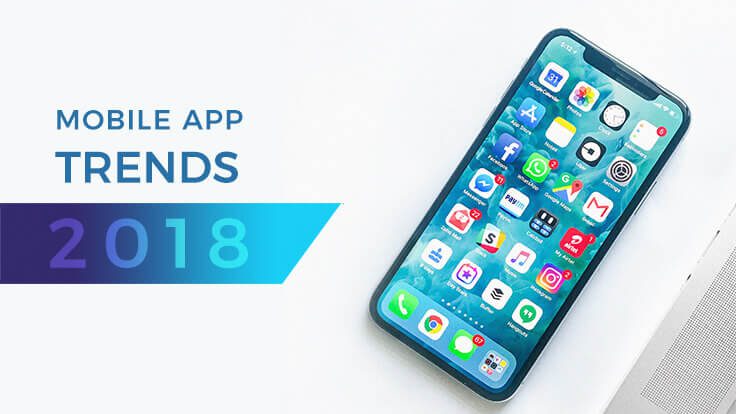
Top Mobile App Trends in 2018 Avakash Dekavadiya The app economy had witnessed solid growth in the last year. With approximately 255 million apps downloaded in 2017, the mobile app market has never been stronger. Businesses have strongly realized how significant mobile apps are to success- not just a fashionable investment. But, 2018 is going to be more disruptive and will force app developers, businesses and marketers to think divergently to take their businesses to new heights. To gain an advantage from your competitors, make sure you take 10 minutes off and enlighten yourself with mobile app development trends that will redefine your businesses in 2018. Here are top mobile App trends in 2018:With the growing presence of alternative digital payment solutions, the world has welcomed words like cashless and contactless in their techno-lexicon. According to Mobile Payments World, the mobile payment industry is expected to turn to $503 Billion industry by 2021- witnessing an annual growth of some 80% from 2015-2021. As per the analysis by Statista, The global mobile payment revenue is expected to cross one trillion dollars in the year 2019Also, increasing number of mobile payment mechanisms are being introduced. Think of the latest initiative of scan and pay system leveraged by Samsung and VISA cards. Integrating m-Payment features in your mobile apps will help you gain a competitive edge and will help you list your app in the list of convenient mobile apps.According to IDC, the worldwide spending on the Internet of Things (IoT) is predicted to reach $772.5 billion in 2018 showing a growth of 14.6% over the $674 billion that was spent in 2017. It also predicts to sustain a CAGR of 14.4% through 2017-2021 surpassing $1 trillion marks in 2020 while reaching $1.1 trillion in 2021. A massive amount of $19 trillion is predicted as profits and cost-savings from the investment in IoT. There’s a dire requirement for high-level programming for sensors, devices, web apps and both B2B and B2C mobile apps.2018 is witnessing smart homes becoming more collaborative. Analysts predict some 1.9 billion smart home devices to be shipped by 2019 which could potentially generate revenue worth $490 billion. IoT integrations involve complicated mobile platforms and elaborate backend infrastructure to enable communication and data sharing between various devices to further enable a combined experience. For example, Beside Amazon’s Alexa, Nest and Ecobee are two budding giants that have pioneered smart home technology. While IoT is gaining popularity from all the domains, it is deeply penetrated in manufacturing, healthcare, and business. Smart cities will dominate the global IoT market share by 26%, followed by industrial IoT with 24% and connected cars with 20%. Wearables A research by IDC indicated an exponential growth in total wearable device reached 115.4 million units from 104.6 million units in 2016 showcasing growth of 10.3%. It is further predicted that by 2021, it will rise up to 222.3 million with a compound annual growth rate (CAGR) of 18.4%.The latest developments recommends the juggernauts of the wearable technology industry to develop products oriented towards applications. According to a research, wearable technology promises to improve productivity by 8.5% and employee satisfaction by 3.5%. Some industries might make optimum use of wearables. For instance, in healthcare sector, surgeons might wear Google Glass to supervise a patient during a crucial surgery without having to interrupt the procedure. Similarly, in manufacturing sector, organizations have used devices like XOne safety glasses which scans barcodes and streams video in real-time to various technicians who are off-site. Blockchain The blockchain is the hottest topic in the tech industry today. While Blockchain is mostly identified with Cryptocurrencies and Fintech, it is worth noticing that this technology can be integrated virtually with any application owing to its security features like encryption and data integrity. Today, 9 in 10 government organizations plan to make investments in blockchain technology for their financial management, asset management, regulatory compliance procedures and contract management. Majority of the banks are expected to adopt blockchain in 2018. The blockchain is not only an irreversible ledger that is being leveraged to facilitate secure mobile payments via apps like Fold, BitPay, Gliph but it also can be optimally used in retail, logistics, real-estate, insurance, stock trading businesses to enhance efficiency. There are several instances of blockchain-dependent apps in the market today like Openbazaar, Chronicled, Riot Blockchain, Storj, BitPesa, with the number of apps and businesses looking to adopt Blockchain for its innumerable benefits is only set to increase in 2018.The app stores are brimming with over 100,000 health apps with a prediction of some 1.7 billion downloads of mhealth apps on various devices only in 2017. It was a tale of past when mHealth apps only showed number of steps a person has taken or may be to book an appointment with their clinician. Today, mHealth has transformed completely. 2018 has been about Electronic Medical Records (EMR) apps that helps you record your medical history, sort your medical bills and keep a check on serious health problems like asthma, diabetes or cancer on phones. Clinicians will step ahead by practicing critical operations using virtual reality based apps. Some of the popular mHealth apps are TotallyPregnant, HelpAround, Fitocracy, Insight Optics, Medici, Digital Pharmacist, Talkspace, Text4Baby, Doctor on demand, HelloMD and many more. AR/VR According to an analysis by Digi-Capital, AR/VR market is expected to hit $150 billion by 2020 with AR dominating with $120 billion followed by VR with $30 billion. With the introduction of Apple’s ARKit and Google’s ARCore in the market, the mobile app industry now has two rock-solid platforms for developing creative AR apps for various mobile devices to provide compelling user engagement and user experience. While AR/VR was restricted merely to gaming industry back in 2017, 2018 shall witness increasing adoption across various traditional industries too. Snapchat and Instagram are the fastest growing social media platforms to leverage AR and further plans to expand to make the platform more engaging and interactive. The use of AR is not limited to just businesses, but it extends to virtually all other
Angular 6 Features. What’s New?

Angular 6 Features. What’s New? Avakash Dekavadiya What makes Angular 6 appealing is that it is the very first release that unifies the CLI, Material and Framework. Note that Angular 6 concentrates more on the toolchain and how to simplify to move quickly with Angular and less on the underlying framework. Furthermore, team Angular is coordinating the major versions stepping forward for the framework packages (@angular/common, @angular/core, @angular/compiler etc), the Angular material + CDK and the Angular CLI. Now, you can effortlessly update your old packages, create native web elements using Angular Elements and many other things with Angular 6. Let’s take a lookng update <package> is a new CLI command that analyzes your package.json and applies its expertise of Angular to suggest updates to your application. It assists you to adopt the right version of dependencies meanwhile keeping your dependencies in synchronization. Third parties can make use of schematics and cater update scripts. NOTE: ng update will not change your package manager. It makes use of yarn or npm to efficiently manage dependencies. While updating peer dependencies, it will apply needed changes to your project ng update @angular/core ng add ng add <package> is a new CLI command that assures to effortlessly allow you to add new capabilities to your project. It makes use of your package manager to download new dependencies while calling upon an installation script which is implemented as a schematic which updates your project with needed configuration changes, adds additional dependencies or stage package-specific initialization code. ng add @angular/pwa Angular Elements Angular 6 introduced us to Angular Element that concentrates on enabling you to bootstrap Angular components within your existing Angular application by recording them as Custom Elements. You can add Angular Elements by running the command below: ng add @angular/elements Angular Material + SDK Components Angular 6 got with it a new tree component which displays hierarchical data. It pursues patterns from the data-table component where the CDK resides the core tree directives. Angular Material caters the same experience with Material Design styles. Angular 6 also introduced new components like new badge and bottom-sheet components. Badge assists to display relevant information like unread item counts while bottom-sheet components represents special type of mobile-centric dialogues that pop from the bottom of viewport which is more commonly used to present a list of options following an action. The @angular/cdk/overlay package is one of the most powerful pieces of infrastructure in the CDK today.CLI WorkspacesCLI version 6 provides support for workspaces comprising of multiple projects like multiple libraries or applications. CLI projects now will leverage angular.json instead of .angular-cli.json for different builds and project configuration. RxJS v6 Making use of the latest version of RxJS library RxJS v6 welcomes a few vital changes besides a backward compatibility package rxjs-compat which keeps applications working. It has been made more tree-shakable to ensure that only pieces of RxJS that you are using are included in your production bundles. Long Term Support (LTS)The Angular team had back in the time announced that only v4 and v6 would be LTS releases but now they have extended LTS to ALL the major releases beginning with v4. Every major release will be actively supported for 18 months with about 6 months of active development followed by 12 months of critical bug fixes and security patches. Library Support The new CLI command ng generate library <name> is a major support for creating and building libraries while configuring it further for testing. In efforts to make your applications smaller, Angular 6 has moved from modules referencing services to services referencing modules. This empowers you to only bundle services into your code base in the modules where they are injected particularly.Animations Performance Improvements[/minti_headline]Angular 6 has upgraded their implementation of animations where it will no longer require the web animations polyfill. This implies that you can erase this polyfill from your application and save some 47KB of bundle size while enhancing and improving performance of animations in Safari.How to update to Angular 6.0.0? The update generally follows 3 steps, and will take advantage of the new ng update tool: Update @angular/cli Update your Angular framework packages Update other dependencies What about Ivy?Ivy is Angular’s next generation rendering in pipeline which is under active development and is not a part of 6.0 release. Angular itself does not contain many innovative changes in the Angular core, but Angular-cli is undoubtedly very appealing. Team Angular is more focused on performance while seamlessly building PWAs, catering a comfortable environment to work in. skip render: ucaddon_next_prev_post